All-on-4 vs Snap-In Dentures: What’s the Real Difference?
All-on-X vs. Snap-In Dentures: What's the Real Difference?
If you've spent an evening reading about snap-in dentures, All-on-X, and implant-supported dentures and ended up more tangled than when you started, you're in good company.
The terms blur together fast, and most explanations assume you already know the things you're trying to figure out. So here's the difference in plain language before anything else: both rely on dental implants as their foundation, but All-on-X is a fixed arch that's permanently attached and never comes out, while snap-in dentures are removable and click onto implants for a much steadier fit than old-fashioned dentures.
That one distinction shapes everything else: what you'll pay, what your mornings look like, how the teeth feel in your mouth, and how you'll care for them over the years. Dr. Michael Fisher, Dr. Marisa Zitterich, Dr. Monica Fisher, Dr. Lauren Houliston and the team at Fisher & Zitterich Dentistry in Rockwall, TX put this together so you can walk into a consultation already knowing the right questions to ask. If you'd rather just talk it through with a person, you can always reach us at (972) 771-4000.
Here's the short version before we dig in:
- Both use implants in the jaw, so neither one slides around the way traditional dentures do.
- Snap-in dentures come out for cleaning, typically rest on four implants (though fewer may be used in some cases), and cost less upfront.
- All-on-X stays in permanently, uses multiple implants per arch, and feels closest to natural teeth.
- The right choice depends on your bone, your budget, and how you want to live with your smile day to day.
- Candidacy for either is something we evaluate together, often without needing bone grafting thanks to how All-on-X implants are angled.
What "Snap-In" Actually Means
You've probably seen the phrase "snap-in dentures" and wondered what it means once you strip away the marketing. It's simpler than it sounds.
A snap-in denture is still a removable appliance. You take it out at night, clean it, and put it back in the morning. In that sense it behaves like a traditional denture. What's different is what holds it steady during the day.
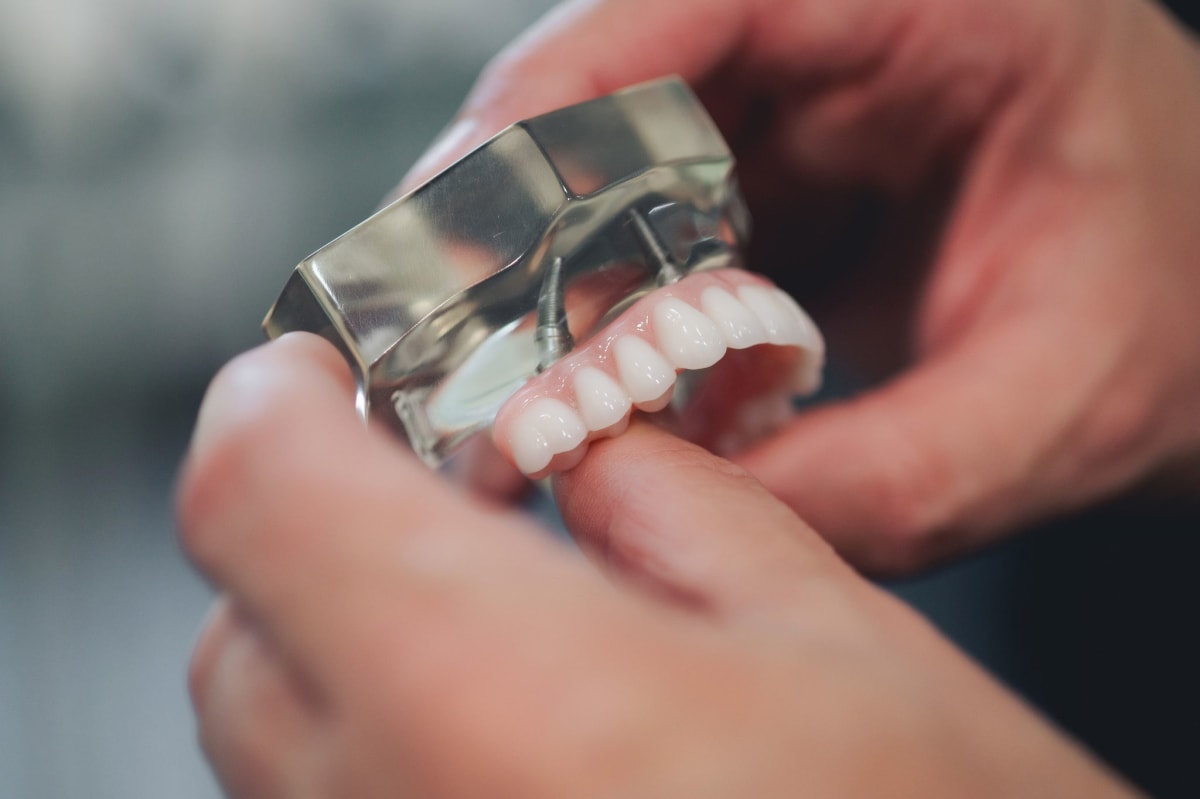
Instead of relying on suction or a tube of adhesive paste, a snap-in denture connects to implants placed in your jawbone. Those implants act as anchors. The underside of the denture has matching attachments that click onto them, which is exactly where the "snap" comes from. We typically place four implants to support a snap-in denture, though the number can vary depending on your anatomy and how much support you need.
Here's what those implants do that no adhesive ever could: they give the denture a solid, fixed point of contact with your jaw. So it stays put when you eat, laugh, or talk. It doesn't slip, and it doesn't lift at the back when you bite into something. For a lot of people, that one upgrade changes how they feel about heading out the door each morning.
The phrase to hold onto is this: snap-in dentures are implant-retained, not implant-supported. The implants steady the denture, but the denture still comes out.
What All-on-X Actually Means
All-on-X describes a full arch of replacement teeth supported by a small number of implants, typically four to six depending on your individual needs. What sets it apart from a standard implant approach is how those implants are placed.
Some go in straight (vertically), while others are tilted, or angled toward the back. That angle is the clever part. By tilting the rear implants, we can reach the denser, more available bone that sits further forward in the jaw. By tilting the rear implants, we can often reach areas of denser, more available bone further forward in the jaw. This can reduce or sometimes eliminate the need for traditional bone grafting in certain All-on-X cases, even when someone has experienced significant bone loss.
Your anatomy is still an important part of determining whether this approach is appropriate, which is why we evaluate your bone volume and overall oral health before recommending a treatment plan, since some patients will require bone grafting, such as sinus lifts, to ensure that there is stable support for their implant prosthesis and to ensure the long term stability of the implants.
If you have been told in the past that you may not be a candidate for a single implant near natural teeth, that does not mean that you are not a candidate for all-on-X.
Once the implants have healed, a full-arch prosthesis is screwed directly onto them. This one does not come out at home. It's not designed to be removed between appointments the way a denture is. It functions far more like natural teeth than any removable option, and that's a big reason people describe it as life-changing rather than just convenient.
Now that you've got a clear picture of both options, the useful question is which one actually fits your life.
The Difference That Changes Daily Life
Knowing how each one works is the starting point. How it actually lands in your everyday routine is the part that tends to matter most.
One comes out, one stays in
Snap-in dentures come out. That's not a flaw, just how they're built. You'll take them out at night, clean them separately, and store them while you sleep. For some people that routine is no big deal. For others, the feeling of taking their teeth out at the end of the day weighs heavier than they expected. Neither reaction is wrong, and it's worth being honest with yourself about which kind of person you are before you decide.
Fixed implant arches stay put. You brush them like natural teeth, you sleep with them in, and there's no case on the bathroom counter and nothing handed to a partner. That sense of continuity means a lot to people who've spent years feeling self-conscious about their smile.
How each one feels in your mouth
There's a physical difference, too. Snap-in dentures usually still have a base that rests along your gumline or covers part of the roof of your mouth, so there's a prosthetic presence you stay aware of. Fixed arches are generally designed with less coverage of the soft tissue, so they feel closer to having your own teeth back. It varies from person to person, but it shapes how the two options feel hour to hour.
If you're running a busy household, holding down a demanding job, and moving through the week at a pace that leaves no room for extra steps, those small differences add up.
Cost, Commitment, and Who Each Option Suits

Picking between snap-in dentures and All-on-X is rarely just a clinical decision. For most people it comes down to three practical things: what you can invest now, what you're willing to manage long-term, and how you want to live with your smile every day.
Snap-in dentures usually involve a lower upfront cost and typically use around 4 implants to anchor them, though fewer may be used in some cases. That makes them an appealing place to start for patients who want real stability without the full surgical and financial commitment of a fixed restoration. Just keep in mind that "lower cost now" and "lower cost overall" aren't always the same thing. Removable appliances need ongoing maintenance, periodic adjustments, and replacement of worn components down the road. Those are honest factors to weigh.
All-on-X is a more involved process, surgically and financially. It's built to be permanent, so the upfront investment is higher. But for someone who wants a fixed arch that functions and feels like natural teeth, that commitment matches what the solution actually delivers.
As for exact pricing, there's no honest one-size number — it depends on your jaw, the number of implants, and the materials involved. What's a good fit for you comes down to a handful of things that get evaluated on a case-by-case basis:
- How much bone volume you have in the jaw
- Your overall health and how well you heal
- Your daily comfort preferences and lifestyle
- Whether a fixed or removable solution fits your long-term goals
If you're starting to sense which column you fall into, that instinct is worth exploring. Our implant dentistry page goes deeper on candidacy if All-on-X feels like it might be the direction for you.
Questions Worth Asking Before Your Consultation
Walking into a consultation with the right questions changes the whole conversation. Instead of leaving with a recommendation you only half-follow, you leave with a plan you actually understand. A few worth bringing along:
"What's my bone situation?"
Missing teeth can cause bone loss, which may affect implant placement. All-on-X angled implants can often work with the bone you have, but some patients may need additional support. For upper-jaw bone loss, a sinus lift can create space for bone grafting and future implant placement. Dr. Fisher or Dr. Zitterich will evaluate your anatomy and recommend the approach that makes the most sense for you. Bone loss doesn't automatically rule out dental implants.
"What does daily maintenance really look like?"
A removable denture and a fixed arch are cleaned very differently. Knowing what your actual morning routine would involve is practical information to have before you commit, not after.
"What happens if something doesn't go as planned?"
It's a fair thing to ask. How the follow-up process works, and how a practice responds when a patient needs extra support, tells you a lot about the care you'll receive long after the procedure is finished. We welcome that question, every time.
Still Weighing Your Options?
If you're sitting with questions after reading this, that's completely normal, and it's not something you should have to sort out on your own.
Whether snap-in dentures or all-on-X ends up being right for you, we'll help you make sense of it for your specific situation, no pressure and no rush. When you're ready to talk it through, give us a call at (972) 771-4000 and we'll take it from there.

Welcome to the Family
Call (972) 771-4000 or request an appointment online to set up your first visit. Our team is excited to welcome you!